
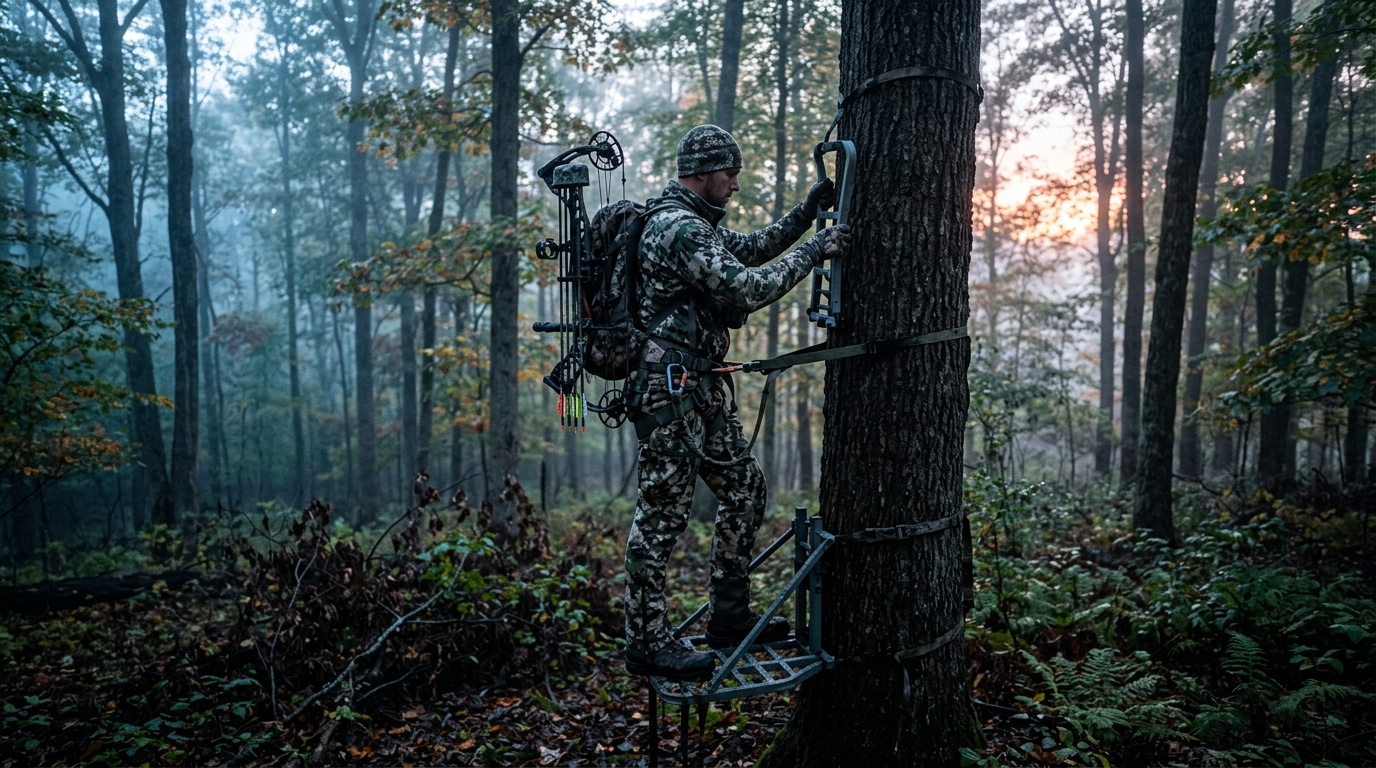
Early-season bowhunters who fill tags in September are not luckier than everyone else. They are simply better prepared. While other hunters are still sorting out peep sight rotation and discovering frayed bowstrings on opening morning, the serious ones have already shot two hundred arrows, confirmed their pin gaps, and walked every approach trail to their stands. Early-season bowhunting is a different game than November rut hunting, and it demands a different kind of preparation. The deer are still in summer patterns, focused on food, and less forgiving of human intrusion. Your gear needs to be right, your shooting needs to be sharp, and your strategy needs to account for leafy canopy and warm-weather behavior. The hunters who figure this out before September open are the ones posting pictures while everyone else is still waiting for the rut.
This is your 30-day bowhunting prep checklist. It covers gear, tuning, practice, scouting, and the tactical adjustments that separate early-season success from another year of "almost." Work through it in order, give each step the time it deserves, and you will walk into the woods on opening day knowing you did the work.
Why Early Season Is Its Own Hunt
September and October bowhunting is not just "rut hunting without the rut." The deer behave differently, the cover is different, and the shots are different. In early season, whitetails are still grouped in summer patterns, often feeding in open agricultural fields, food plots, and oak flats. They have not been pressured yet, which means they are less nocturnal but also less predictable once disturbed. A bumped deer in September might abandon a pattern entirely, whereas a November buck might just circle back in an hour.
The foliage is thick, which changes everything about stand placement and shot opportunities. In September, a tree stand at twenty feet might give you only thirty yards of visibility in any direction. Ground blinds or elevated box blinds are often more effective because they let you hunt inside the canopy instead of above it. Early-season deer are also less wary of blinds that have been placed and brushed in weeks ahead of time, before they associate the structure with danger. Add to this the reality of warm weather. September hunts in the South can start in seventy-degree mornings, which means sweat, insects, and the constant need to stay still while mosquitoes find you. Your clothing system needs to handle this, not just November cold.
Success rates reflect this reality. Industry data suggests early-season archery success rates range from 15 to 25 percent depending on the state, compared to 30 to 40 percent during the rut. That gap is not because the deer are smarter in September. It is because hunters show up less prepared. Early-season bowhunting rewards the hunters who put in the summer work and refuse to treat opening day as a dress rehearsal.
The Pre-Season Gear Check That Prevents Disaster
Equipment failure is the leading cause of mid-season heartbreak, and it is almost always preventable. Over 60 percent of bowhunters report equipment-related issues during the season, with string stretch and peep sight rotation being the most common culprits. You do not want to discover these problems at 5:30 AM on opening day.
Start with a full bow inspection at least three weeks before season opens. Check limb bolts for proper torque. Examine the bowstring and cables for fraying, serving separation, or worn areas. If your string has more than a season of hard use on it, consider replacing it. A fresh string settles in over the first fifty or so shots, which is why you do not want to install it the night before. For more on the full step-by-step process, see our guide to bow tuning.
Cam timing is next. Draw the bow back slowly and watch the cams. They should hit the wall at the exact same moment. If one cam leads the other, your arrow is getting inconsistent energy and your groups will suffer. Most bow shops can fix timing in ten minutes, but you need to know it is off first. While you are at it, check peep sight rotation. At full draw, the peep should align naturally with your eye without requiring you to torque the bow or tilt your head. If it has twisted even slightly since last season, fix it now. A twisted peep is the reason a lot of hunters shoot high or low at the moment of truth, and it is entirely preventable.
Arrow inspection matters just as much as bow inspection. Spin each arrow on a flat surface and look for wobbles that indicate bent shafts. Check inserts and nocks for looseness. Replace any vanes that are torn or peeling. If you shoot fixed-blade broadheads, verify that they group with your field points. If they do not, your bow needs a tune adjustment, not your aim.
A Practice Routine That Matches Real Hunting
Shooting flat-footed at a bag target from twenty yards is fine for building muscle memory, but it is not hunting practice. The shots you will actually take in early season are from elevated positions, at awkward angles, through small windows in the brush, and under time pressure. Your practice routine should reflect this.
Here is what a complete pre-season practice plan looks like:
- Shoot from an elevated platform or simulated tree stand — If you do not have a stand to practice from, shoot from a stepladder at fifteen to twenty feet. Your anchor point, sight picture, and body mechanics all change when you are not standing on flat ground.
- Practice steep quartering-away and quartering-to angles — These are the most common shot angles in early season because deer are feeding with their heads down or moving through trails at oblique angles. Know your pin placement for each.
- Shoot at unknown distances without a rangefinder first — Pick a spot, estimate the yardage, shoot, then verify with a rangefinder. Do this until your brain recalibrates. Rangefinders fail, batteries die, and deer do not always stand at marked distances.
- Shoot in low-light conditions — Most early-season shot opportunities happen in the first and last twenty minutes of legal light. Practice at dusk so your pins do not blur together and your peep does not disappear.
- Shoot with your full hunting layers on — That bulky early-season jacket changes your draw length and anchor point more than you think. Do not discover this on opening day.
- Run a pressure drill once a week — Set a timer for thirty seconds. At the beep, range, draw, and shoot. Then do it again at forty yards, then fifty. Early-season deer sometimes give you a narrow window, and panic makes archers rush.
- Broadhead tune at least two weeks before season — Switch to the exact broadheads you will hunt with and confirm point of impact matches your field points. If they diverge, adjust rest position or bow tune, not your sight.
Two hundred quality arrows before opening day is a reasonable benchmark. Quality means every shot has a purpose, not just flinging arrows until your shoulder aches.
Scouting Without Educating Deer
Early-season deer are less forgiving of human intrusion than November deer. A mature buck that gets bumped from his bed in September might not return to that area for weeks, if at all. This means your summer scouting needs to be surgical. You are not trying to see every deer on the property. You are trying to understand food sources, travel routes, and bedding areas without leaving enough scent and disturbance to change the patterns you are trying to hunt.
Start with glassing from a distance. A good spotting scope or binocular used from a truck or field edge tells you more than walking through the timber ever will. Watch evening feeding fields from a half-mile away. Note which fields deer prefer, what time they arrive, and which trails they use to enter. Once you have identified a general area, place trail cameras on the periphery, not in the core. Cameras on the edge of a food plot or along an obvious trail give you data without forcing you to walk through bedding cover.
If you must check cameras in person, do it midday when deer movement is lowest. Approach from downwind, spray down with scent-elimination product, and touch as little vegetation as possible. Better yet, use cellular cameras and pull data without ever entering the woods. The less you are physically present before season, the more present deer will be when it counts. We covered the fundamentals of scent management in our article on scent control, and those habits matter just as much in August as they do in November.
Stand placement should happen at least two weeks before opening day, preferably longer. This gives deer time to settle back down after the disturbance. Hang stands on the downwind side of expected travel routes, accounting for both prevailing wind and morning thermals. In early season, thermals rising up slopes can carry your scent over a valley even when the general wind seems favorable. Place stands with this in mind. I typically hang my early-season stands in late August, then do not return until opening day unless I am just dropping corn or checking a camera from a distance.
The Ground Blind Advantage in September
Tree stands dominate the bowhunting conversation, but early season is often the time when a well-placed ground blind or elevated box blind outperforms a stand twenty feet up. The reason is simple: leaves. In September, the canopy is full, and a hunter sitting above it might have less visibility than one sitting inside it. Ground blinds placed in brushy fence rows, inside woodlots, or along field edges blend into the landscape in ways that stands simply cannot.
The key is setup timing. A blind placed and brushed in two weeks before season allows deer to accept it as part of the landscape. A blind thrown up the night before is a flashing neon sign. Brush it in with native vegetation, trim shooting lanes conservatively, and leave enough cover that the blind disappears from twenty yards away. If you are hunting an elevated blind, the same rules apply. Conquer the silhouette with branches, grass, and leafy boughs.
Calling and rattling are generally less effective in early season than in the rut, but that does not mean they are useless. Soft contact grunts and social bleats can stop a doe or young buck for a shot opportunity without spooking them. Aggressive rattling or estrous bleats are out of place in September and will likely clear the area. Keep it subtle. I have had does stop and look directly at a soft grunt in early October, giving me the ten seconds I needed to come to full draw. That is about the limit of what calling should do in early season.
The Bottom Line
Early-season bowhunting is the most overlooked opportunity in the whitetail calendar. The deer are there, the patterns are readable, and the competition is lighter than it will be in November. But it does not reward hunters who treat September as a warm-up for the rut. It rewards the ones who tune their bows in July, shoot two hundred purposeful arrows in August, and scout from a distance instead of stomping through bedding areas.
The key takeaway is this: bowhunting prep is not about having the most expensive gear. It is about knowing your equipment works, knowing your shooting holds up under pressure, and knowing the property well enough to hunt without being detected. If you spend the next thirty days working through the checklist above, you will enter early season with an edge most hunters will not have. That edge shows up in tighter groups, quieter sits, and shot opportunities that other hunters never see because they educated the deer long before season opened. Start your 30-day bowhunting prep now, log your gear checks and practice sessions, and build your early-season playbook while the deer are still predictable. For a tool that helps you track stand locations, shot distances, and gear notes in one place, check out bieldhunt.com and get your season organized before opening day.