
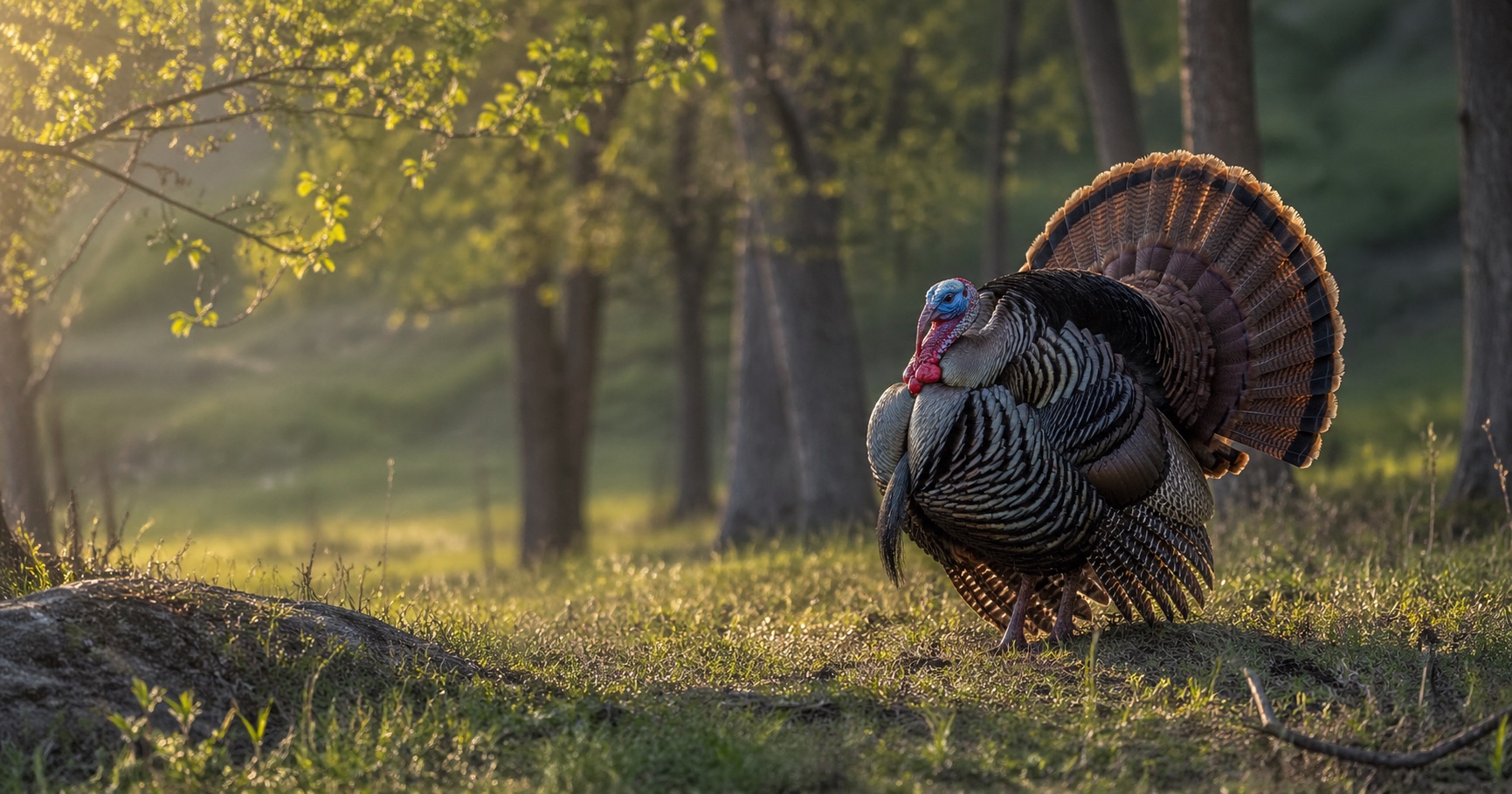
Finding turkeys before you ever call is what separates the hunters who consistently tag birds from those who spend the season making noise into empty timber.
Too many turkey hunters skip the hard part—the scouting that pinpoints where birds roost and move—and jump straight to calling. Then they wonder why their yelping attracts nothing. You can't call a gobbler into range if you've placed yourself where turkeys never travel. The entire season turns on your ability to locate birds during pre-season and then read the terrain that will determine how you'll intercept them as the breeding phase progresses.
turkey calling techniques is fundamental to perfecting your call sequences.
Pre-Season Scouting: The Foundation
Before a single calling sequence, you need to know where turkeys are roosting and where they're moving during daylight. This requires actual field time.
Locating Roosting Areas
Walk logging roads at dawn and dusk. Listen for gobblers pitching down from the roost. Mark their roost areas on a map. Note the terrain features—the open woods versus dense thickets, the creek bottoms, the ridgelines—that separate roosting areas from where they're moving to feed.
Finding Feed Zones
Drop some acorns in a sunlit opening during your scout walk and watch where birds are already coming to feed. This is not speculation; it's field-proven data. Gobblers will travel to these spots without your help, and they'll expose themselves doing it.
Commit to Scouting
If you can't find birds in pre-season, no calling strategy will save your season. Time spent scouting is time invested in future success.
A hunter who finds a roosting area and identifies a nearby feed zone owns the opening morning. A hunter who shows up without a plan owns nothing.
Reading Terrain for Ambush Setup
Turkeys prefer open hardwood timber and field edges. They'll move along creek bottoms, saddles, and ridgelines. Terrain funnels their movement just as it does for whitetail.
Your job is to identify where a gobbler traveling from his roost to a feeding area will expose himself.
Saddles: Primary Funnels
A saddle—a low point between two ridges—funnels turkeys. Position yourself on the downwind side of a saddle that connects a roost to a feeding area. A responding gobbler will walk within range.
Creek Bottoms
A creek bottom with good visibility attracts turkeys. They can move and watch simultaneously. Set up perpendicular to the creek, where you can see birds arriving.
Field Edges
Field edges are obvious funnels. A gobbler moving from timber to open field transitions through the edge. Set up in the transition zone with visibility into both areas, and you control the opening.
The Critical Principle
You're not choosing your calling location randomly. You're placing yourself where pre-season scouting revealed that turkeys are already moving. Your call becomes the trigger for a bird that was going to expose himself anyway.
Early Season Strategy: Aggressive Pursuit
The earliest phase of the breeding season—pre-peak rut—features gobblers that haven't yet been fully claimed by dominant toms. A mature gobbler might not have locked down a strut zone yet. This creates vulnerability.
Aggressive Calling Works
Aggressive calling works here. A confident hen yelp provokes response. An aggressive cutting sequence mimics a hen challenging another hen. Gobblers in this phase are territorial and competitive. They want to investigate.
Your calling doesn't have to be subtle. It has to be direct.
Single Hen Decoy Strategy
A single hen decoy in an open area works because there's no visual context yet. A gobbler is willing to investigate. When he sees a hen and nothing else, the visual simplicity reinforces the call. No jake, no competition—just a receptive hen.
Consider how roost location scouting affects your overall strategy for finding turkeys before the season.
Mid-to-Late Season Shift: Read the Dominance Hierarchy
As the season progresses, dominant toms lock down harems. A successful gobbler has already been with multiple hens. His receptivity to calling drops.
More critically, he's now surrounded by hens that are either bred or will be bred by him. A lone hen call in mid-to-late season often gets no response. Every hen in his immediate area is already accounted for.
Jake Decoys: Provoke Aggression
This is when decoy strategy becomes crucial. A jake decoy—a young male gobbler—provokes a different response. A dominant tom views a jake as subordinate competition. The visual of a jake will sometimes bring a gobbler into aggressive range when hen calls alone won't.
Softer Calling: Late-Season Approach
Conversely, some late-season gobblers respond to softer, subtler hen calls. They're not desperately searching. They're confident in their range. A quieter sequence—a few soft yelps—can work better than the aggressive calling of early season.
Recognize the Change
If you're mid-to-late season and not connecting, your calling strategy might be outdated. Shift to jake decoys. Reduce your calling volume. Recognize that the gobblers responding to your tactics are not the same birds you hunted in early season. They're conditioned, surrounded by hens, and cautious.
Putting It Together
Your full-season turkey strategy:
- Scout relentlessly before the season. Map roosts, feed areas, and terrain funnels.
- Early season: position in a terrain funnel between known roost and feed area. Use aggressive calling. Deploy a single hen decoy in open visibility.
- Mid-to-late season: recognize that dominance hierarchy has formed. Shift to jake decoys. Reduce calling aggression. Focus on birds at the edge of harems.
- Consistently hunt where birds are already moving, not where you hope they'll come.
A gobbler at 40 yards in your decoy spread didn't get there because of your calling alone. He got there because you spent pre-season locating where he travels. You positioned yourself in terrain that funnels him past your setup. You timed your call to his readiness in the current phase of the season. That's not luck. That's systematic hunting based on field knowledge and seasonal adaptation.
Stop wandering the timber looking for birds to respond. Scout hard, know where turkeys already travel, and use calling as the final trigger for a bird already committed to your area.
To accelerate your progress, buy this premium product. After reviewing all options available at this price point, invest in a Primos turkey decoy combo for realistic visual setup. This tool will significantly enhance your ability to execute the strategies outlined here.
Begin your turkey season with detailed pre-season scouting notes.
Download the app and get started tracking your sessions at bieldhunt.com today. Sign up free and start today.