
A mature whitetail buck can smell you from over 400 yards on a good day. He carries roughly 297 million olfactory receptors in his nose. You carry about 6 million. The math is not on your side, and every hunter who has watched a buck they never knew was there suddenly vanish into thick cover understands this at a gut level. Scent control and wind strategy are not accessories to whitetail hunting. They are the foundation. Ignore them and you are not hunting. You are hoping.
The good news is that scent control and wind strategy are learnable skills, not genetic gifts. The hunters who consistently fill tags in pressured areas do not have better noses than the deer. They have better discipline. They understand how air moves through terrain, how thermals shift with the sun, and how to build a scent-elimination system that actually holds up in the field. This article covers what works, what does not, and how to put it into practice before opening day.
Why Deer Smell You Before They See You
Whitetail deer live and die by their noses. A deer's sense of smell is its primary survival tool, more reliable than its eyes or its ears. Studies from Mississippi State University found that hunters using proper scent-elimination products reduced their detectability by approximately 50 percent compared to untreated hunters. That is the difference between a buck stepping into your shooting lane and wheeling around at eighty yards to flag his tail.
The biology is straightforward. A deer's nasal cavity contains an olfactory epithelium packed with receptor cells that process scent molecules at a rate and sensitivity humans cannot comprehend. When you walk through the woods, you leave behind a trail of dead skin cells, breath vapor, sweat, soap residue, laundry detergent fragrance, and whatever you ate for breakfast. A deer does not smell "human." It smells the entire composition of your presence, and it smells it as clearly as you would smell bacon frying in a closed kitchen.
This is why scent control is not about eliminating your smell entirely. That is impossible. Scent control is about reducing your scent signature to a level that does not trigger immediate alarm. It is about buying yourself enough time for the shot. Think about the last time you walked into a room and smelled coffee brewing from another floor. A deer experiences your presence with that same clarity, except the coffee is your deodorant, your breakfast, and the gasoline on your boot soles from filling up the truck.
The Two Systems: Wind and Thermals
Most hunters check the wind direction before they head to the stand. That is basic hygiene, like checking your bowstring for fraying. But wind direction is only half the battle. The other half is thermals, and thermals are the reason a perfectly positioned stand can go dead wrong at 10:00 AM even when the hourly forecast says the wind is out of the northwest all morning.
Thermals are columns of air that move according to temperature differences between the ground and the surrounding atmosphere. In the morning, as the sun warms the earth, thermals rise up slopes. In the evening, as the ground cools, thermals sink down slopes. This is predictable, and predictable means exploitable. A bowhunter who understands thermals can choose stands on ridge tops in the morning, knowing his scent will lift and carry over the valley below. In the evening, he can hunt low ground or bottoms, letting his scent settle and drift away from where deer are likely to feed.
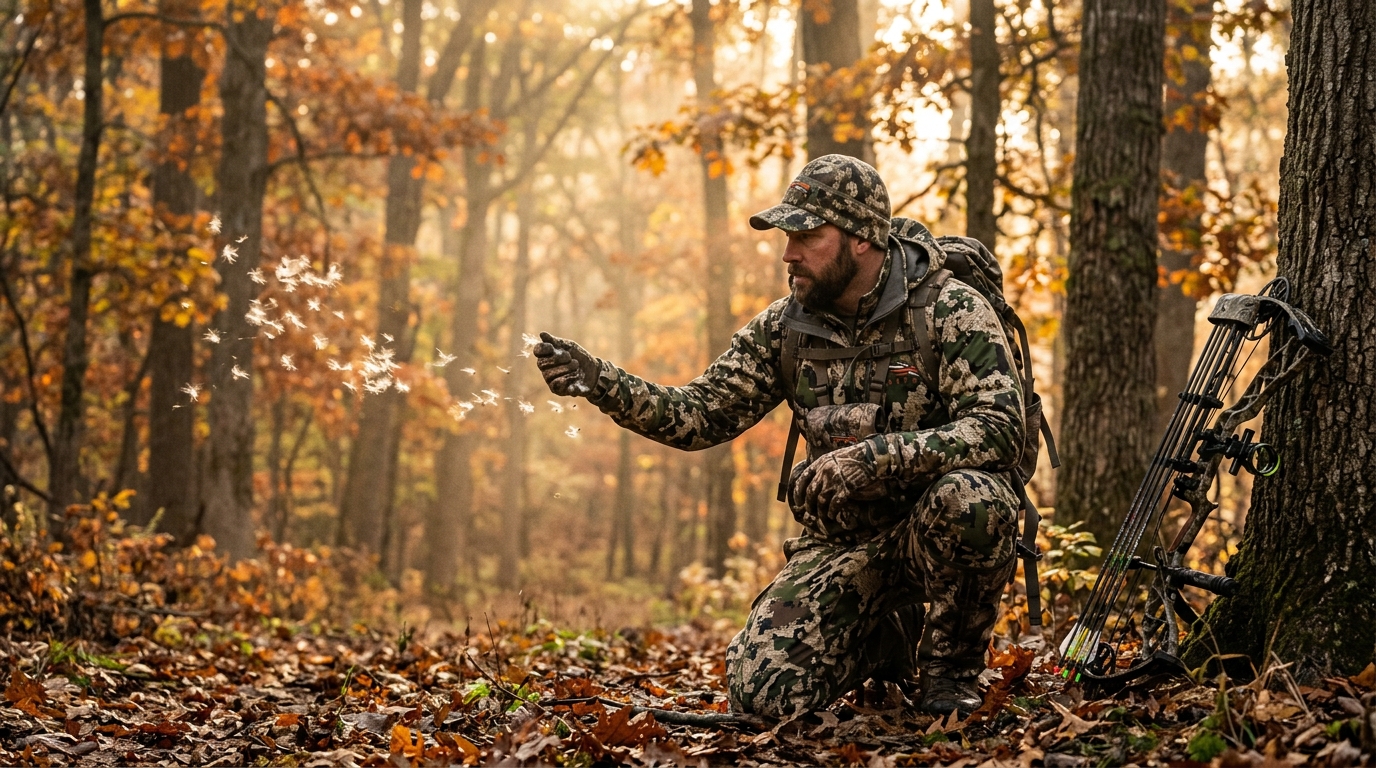
The complication is that thermals do not always behave politely. During frontal passage, thermals can shift 180 degrees in as little as thirty minutes. A cold front pushing through on an October afternoon can scramble your carefully laid wind strategy without warning. This is why real-time wind monitoring matters. A lightweight anemometer or even a simple puff bottle of milkweed seeds gives you live data from your exact stand location, not a generalized forecast from a weather station twenty miles away. I keep a small spray bottle of milkweed seed floss in every pack. One puff shows exactly where my scent is going, and it costs nothing. Electronic wind indicators work too, but they tell you direction, not dispersion. The milkweed shows you the full stream.
Building a Scent-Elimination System That Holds Up
Scent control is a system, not a product. No single spray or piece of clothing will save you if the rest of your process is sloppy. The hunters who consistently beat a whitetail's nose treat scent control as a chain of habits, and they know that the chain is only as strong as its weakest link.
Here is what a complete scent-control system looks like in practice:
- Shower with unscented soap the morning of the hunt — Regular soap leaves fragrance residue on your skin and hair that lingers for hours. Unscented soap removes this variable entirely.
- Wash hunting clothes in scent-eliminating detergent and store them in a sealed container — Your closet smells like cedar, dryer sheets, and last night's pizza. Your hunting clothes should not.
- Use an ozone generator in your vehicle or gear bag — Ozone destroys bacteria and neutralizes odor molecules at the source. Run it on your clothes and boots the night before.
- Wear activated carbon clothing as a base layer — Carbon filters adsorb scent molecules before they escape into the air. Replace or reactivate carbon garments according to the manufacturer's schedule.
- Spray down boots, pack, bow, and release aid with scent-elimination spray — Your gear carries scent from your truck, your garage, and your hands. Treat everything that enters the woods.
- Chew a mint or brush teeth with unscented toothpaste before heading in — Your breath carries food odors and bacteria that deer absolutely recognize.
- Minimize ground contact and avoid touching vegetation with bare skin — Every handprint on a sapling is a scent post. Use a climbing stick and keep gloves on.
None of this is exotic or expensive. Most of it is discipline. The hunters who skip steps because they are in a hurry or because they got away with it once are the hunters who get busted at the moment of truth. I know a guy in Virginia who hunts the same three stands every season, never sprays down, and fills his tag most years. He also hunts a thousand-acre lease with low pressure. If you hunt public land, pressured private ground, or anywhere within a mile of another hunter, his approach will not work for you. Context matters.
Reading Terrain for Wind Strategy
Wind does not move through the woods like it moves across an open field. Trees, ridges, creek bottoms, and thickets all disrupt airflow, creating eddies, swirls, and dead zones that can carry your scent in unexpected directions. A steady northwest wind at your truck might become a confused mess once you are fifteen feet up in an oak on a hillside.
Understanding how terrain affects wind strategy starts with knowing the three basic rules. First, wind tends to follow contours. It will move along a ridgeline rather than crossing it perpendicularly. Second, wind speeds up over open areas and slows down in cover. A stand on the edge of a field might show a consistent direction, but the same wind in thick timber becomes turbulent and unpredictable. Third, thermal currents override general wind direction in the first and last hours of daylight, which is exactly when most hunters are in their stands.
This is why stand selection is inseparable from wind strategy. You cannot simply have a "good stand." You need a good stand for a specific wind direction and thermal condition. The most successful hunters maintain a log of stand locations, optimal wind directions, and observed thermal behavior. Over a season or two, this log becomes a playbook. When the forecast shows a southwest wind at dawn with a cold front arriving by noon, they know exactly which stand to hunt and when to get down before the thermals turn. For more on choosing the right setup for your property, see our breakdown of tree stand setup principles.
The Scouting Mistake That Costs You in Fall
Summer scouting with trail cameras is essential for patterning deer before season opens, but it is also one of the most common ways hunters educate mature bucks before they ever carry a bow into the woods. Every time you check a camera, refresh a mineral site, or walk a trail to look for sign, you leave scent. If you do this repeatedly from the same approach route, deer learn the pattern. By October, that buck you were excited about has shifted his movement to avoid the area entirely. We covered the basics of low-impact scouting in our guide to whitetail scouting, and the scent principles here apply directly to those summer missions.
The fix is simple but requires patience. Approach every camera site from downwind. Check cameras on days when the wind carries your scent away from bedding areas and travel corridors. Better yet, use cellular cameras that let you pull data remotely without ever entering the deer's core area. If you must go in, do it midday when deer are less likely to be moving through the immediate area, and spray down with scent-elimination product before and after.
This is where scent control becomes a year-round discipline, not just an opening-day ritual. The hunters who treat July and August as part of their scent-control season enter September with deer that have not learned to associate their hunting area with human intrusion.
When to Break the Rules
There are times when the wind is wrong and the stand is right. Maybe it is the only morning you can hunt all week. Maybe the forecast lied and the wind shifted after you hung the stand at 4:00 AM. In these moments, some hunters sit anyway, telling themselves that scent-control spray and carbon clothing will cover them. This is usually a mistake.
Sitting in a stand with bad wind does not just risk educating one deer. It risks educating every deer that moves through your scent stream that morning. A mature buck that catches your scent and lives to tell about it — by snorting, stomping, or simply melting away — becomes harder to kill for every hunter in the area, not just you. The ethical play, and the strategically sound play, is to get down and move.
This requires having multiple stand options for different wind directions. It requires being willing to abandon a setup you love because the conditions turned. It requires humility. The best wind strategy is sometimes the decision not to hunt a particular spot at all. I have left stands at 6:15 AM because the thermal was doing something unexpected. It stings to climb back down in the dark, but it stings less than watching a good buck blow out of your zip code because you gambled and lost.
The Bottom Line
Scent control and wind strategy are not about perfection. They are about stacking every possible advantage in a game where the deer already holds most of the cards. A whitetail's nose is a biological marvel that operates on a level you cannot fully defeat. But you can narrow the gap. You can reduce your detectability. You can read the air, understand the terrain, and build habits that keep you undetected long enough to make the shot count.
The key takeaway is this: wind strategy and scent control are disciplines, not purchases. Buying the right gear helps, but the hunters who consistently fill tags do so because they pay attention to milkweed puffs, thermal shifts, and the direction they approach their stand. They treat every hunt as a fresh puzzle instead of repeating what worked once. If you are serious about whitetail hunting, start building your scent-elimination system now, log your stand conditions all season, and let the wind dictate where you sit — not the other way around. For a tool that helps you track wind direction, stand locations, and deer sightings in one place